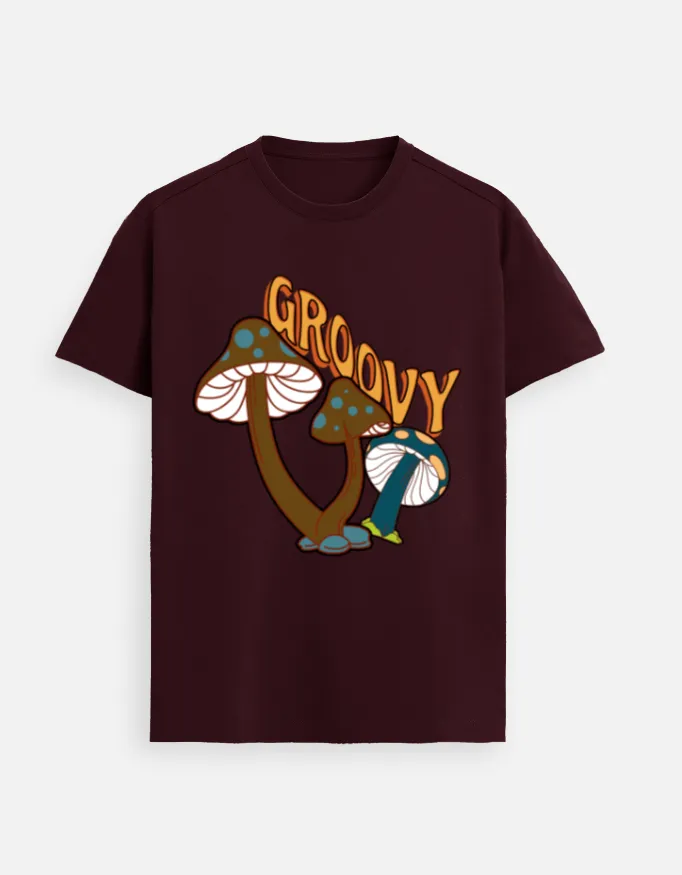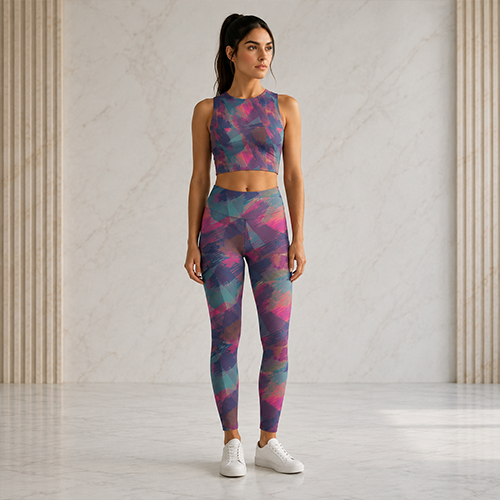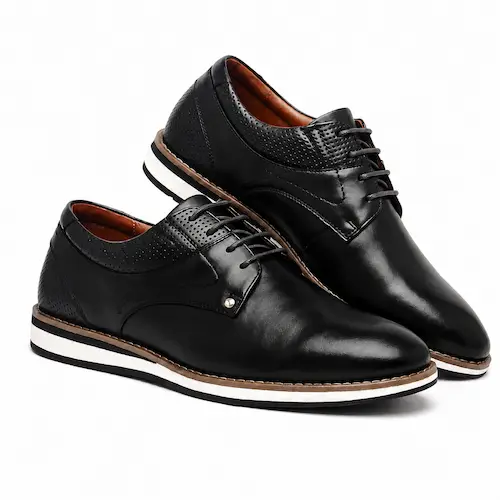
-49% Hot
Price range: ₹359.00 through ₹699.00
-43% Hot
Original price was: ₹699.00.₹399.00Current price is: ₹399.00.
-44% New
Price range: ₹249.00 through ₹449.00
-53% Hot
Price range: ₹300.00 through ₹470.00
 Vegan Food
 Baby & Mom
 Beauty
 Fashion
 Pet & Animal Care
 Health & Wellness
 Home & Cleaning Essentials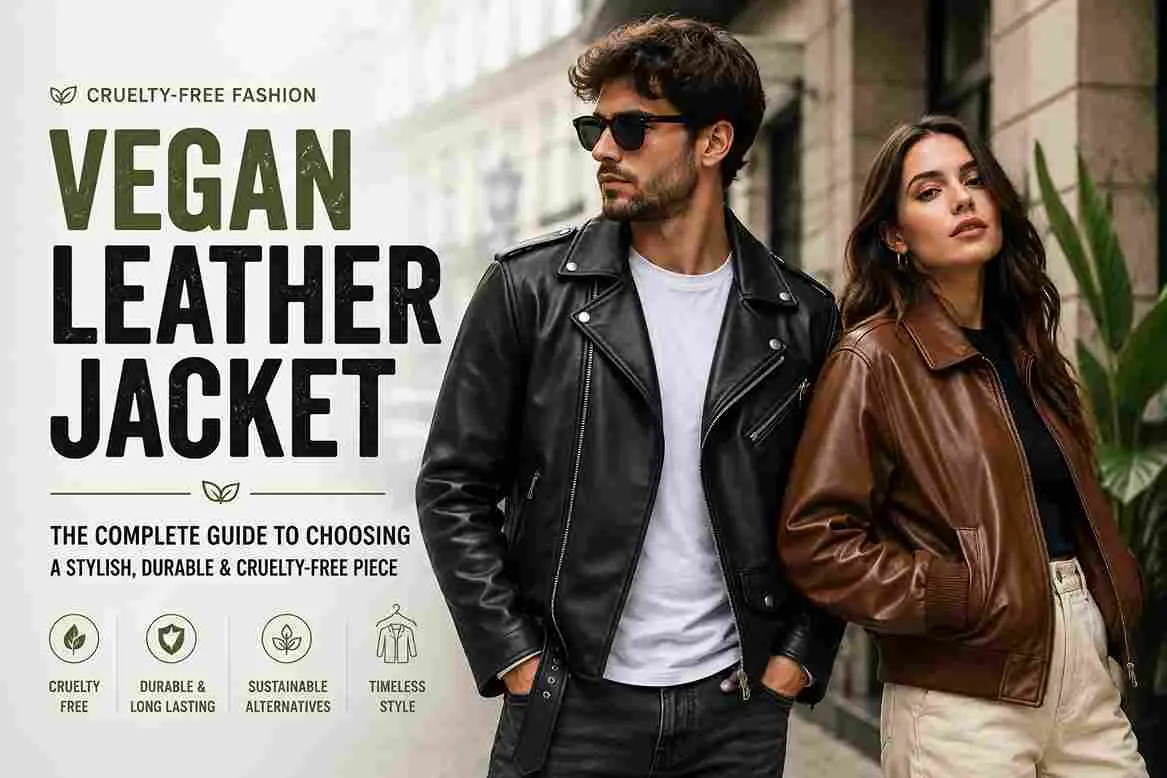
A great jacket says a lot before you say a word, and for a growing number of shoppers, that statement now includes “no animals were harmed.” Vegan leather jackets have moved from niche alternative to mainstream wardrobe staple, and for good reason: modern versions look sharp, cost less, and come in materials that didn’t exist a decade ago. This guide walks through everything worth knowing before you buy one — from the science behind the material to how to keep it looking new for years.
A vegan leather jacket is any jacket made from a leather-like material that contains no animal hide, skin, or animal-derived glue or finish. The term covers a surprisingly wide spectrum of materials, from long-standing plastic-based synthetics to newer plant-based innovations made from fruit waste, cactus, and mushrooms.
Real leather is animal skin, mostly cow skin, which has undergone tanning, usually through chemicals like chromium salts, in order to preserve it and give it elasticity. Vegan leather on the other hand produces leather-like fabric over a fabric substrate such as polyester or cotton or vegetative fibers with resin.
Consumer demand for cruelty-free fashion has pushed brands to invest heavily in better-looking, better-performing synthetic and plant-based leathers. What used to be dismissed as cheap “pleather” now includes premium materials that can be difficult to distinguish from animal hide at a glance, which is a major reason vegan leather jackets have found a permanent place on runways and in everyday closets alike.
The most obvious draw is that no animal is killed or farmed to make the jacket. For shoppers who want the leather aesthetic without the ethical trade-off, this is the deciding factor.
If you’re new to ethical fashion, you can also learn more about how vegan fashion differs from traditional leather production through PETA’s Vegan Fashion Guide.
Leather production using methods uses a lot of water and chemicals. This means that making one square meter of leather can use thousands of liters of water. The water that runs off after this process contains chrome. This runoff needs treatments to stop it from polluting water sources.. There are new kinds of leather made from plants.
For example leather made from mushroom and cactus fibers uses less water.. Even though these are vegan leathers it is important to remember that not all vegan leathers are good for the environment.For more information about the environmental impacts of textiles and leather production, refer to the UNEP, which provides resources on sustainable manufacturing and responsible leather practices.
Because vegan leather can be manufactured in consistent sheets, brands can experiment more freely with texture, color, and finish than they can with natural hide, which varies from animal to animal. That means more design freedom and more options for shoppers.
Without the cost of raising livestock or running a tannery, vegan leather jackets are typically priced well below their genuine-leather counterparts, making the leather look accessible to a much wider range of budgets.
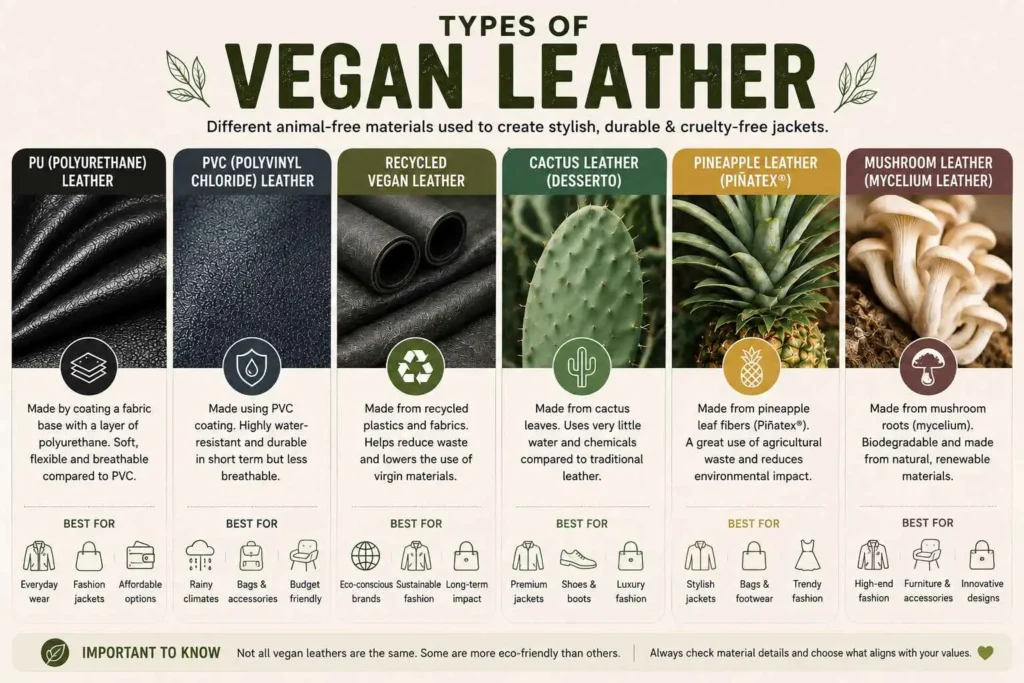
PU leather is the most widely used vegan leather on the market. It’s made by coating a fabric backing with a flexible polyurethane layer. It’s soft, breathes better than PVC, and is generally considered the more environmentally responsible of the two mainstream plastic-based options — though it’s still petroleum-based and not biodegradable, and it can crack or peel with age if not cared for.
PVC (polyvinyl chloride) leather uses a thicker plastic coating and is highly water-resistant and durable in the short term. It’s also considered the least eco-friendly mainstream option, since production and disposal involve more toxic byproducts, and it tends to be less breathable and more prone to becoming stiff or brittle over time.
Some manufacturers now build vegan leather from recycled plastics, including reclaimed polyester, reducing the need for virgin petroleum-based materials while keeping the familiar PU or PVC-style finish.
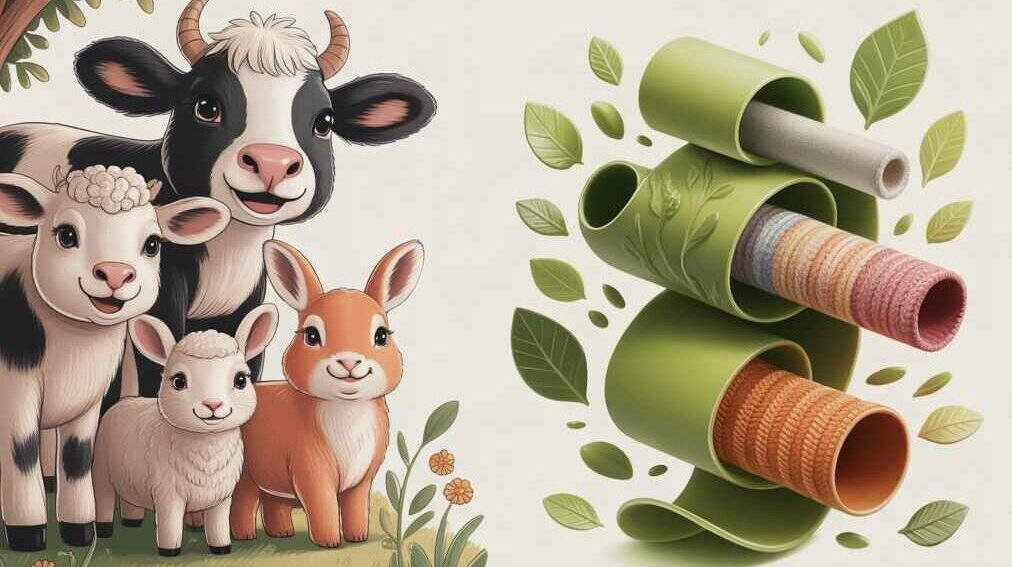
This is the fastest growing category. Instead of being purely plastic, these materials use agricultural byproducts: Piñatex (pineapple leaf fiber), apple peel and pomace leather, Desserto (cactus leather), mushroom mycelium leather and cork leather. Most still have some synthetic binder to provide durability and flexibility, so “plant-based” isn’t always “plastic free”, but the plastic content is usually much lower than standard PU or PVC.Learn more about these innovative materials from the official manufacturers:
There’s not just one winner. PU provides a good mix of softness, cost, and durability. PVC wins on short term water resistance, but loses on eco-credentials and long term flexibility. Plant-based leathers have the smallest environmental impact but they may not be as durable over time as the technology is evolving. For a jacket that will last, generally, a properly made PU leather or a trustworthy plant-based blend, with reinforced stitching is the safer bet.
Vegan leather doesn’t stretch and mold to the body the way animal hide can, so fit matters more at the point of purchase. Try to match the silhouette to your frame rather than counting on the material to “break in.”
Run your hand across the surface. Cheaper PU/PVC feels stiff, shiny, or slightly tacky, while better-quality vegan leather has a softer, matte-to-semi-gloss finish and moves more naturally.
Check seams at the shoulders, underarms, and cuffs — the areas that flex the most. Loose or uneven stitching is often the first place a cheaply made jacket fails.
A breathable lining (cotton, viscose, or a quilted polyester blend) makes a big difference in comfort, since vegan leather itself doesn’t breathe as well as natural fibers.
Most vegan leather jackets offer decent water resistance but aren’t built for sustained cold-weather insulation on their own — check whether the jacket includes or accepts a warm liner if you plan to wear it through winter.
Metal (rather than plastic) zippers, snaps, and buckles tend to hold up better over years of use and are a good indicator of overall build quality.
Asymmetric zip, wide lapels, and a fitted waist — the classic silhouette borrowed from motorcycle culture.
Closely related to the biker style, often with more streamlined hardware and a slightly cleaner cut.
Ribbed cuffs and hem, a relaxed fit, and a shorter length make this one of the most versatile everyday options.
Ends at or above the waist, popular for pairing with high-waisted bottoms.
Structured shoulders and a lapel collar bring vegan leather into smart-casual and office-appropriate territory.
A relaxed, boxy fit that layers easily over sweaters and hoodies.
Combines the leather look with the practicality of a built-in or detachable hood, popular in streetwear.
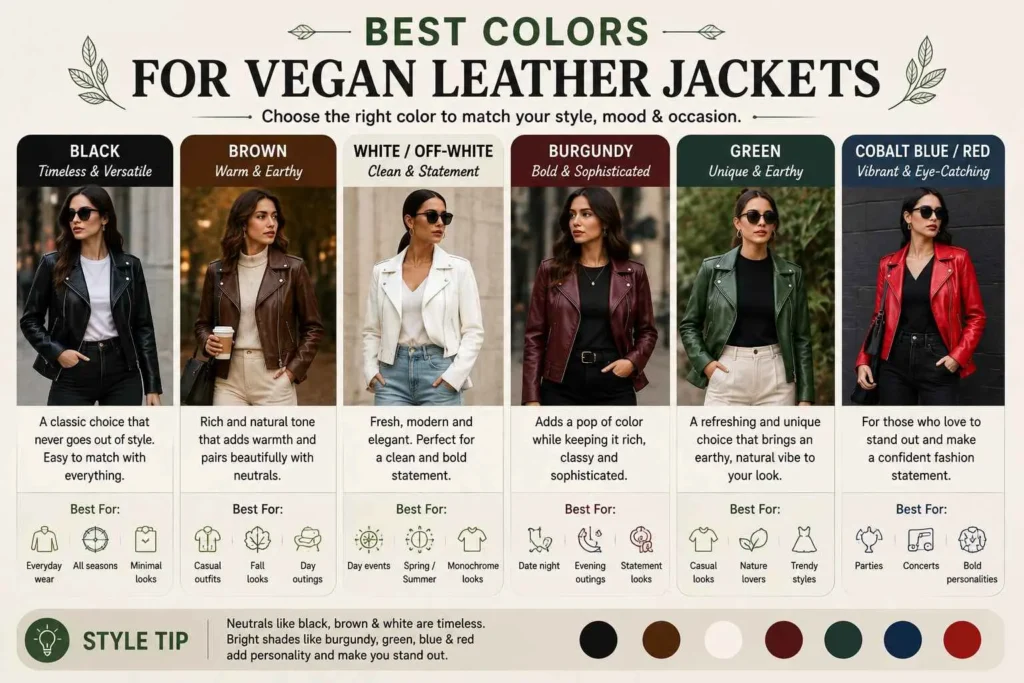
The most versatile choice, pairing with virtually any outfit and any season.
Warmer, slightly more casual than black, and pairs especially well with denim and earth tones.
A bold, statement option that stands out but requires more careful maintenance to avoid visible stains.
Deep, muted tones that add personality without straying from a neutral wardrobe.
Brighter shades — cobalt, red, or pastel tones — show up in seasonal collections for those who want a leather jacket to double as a statement piece.
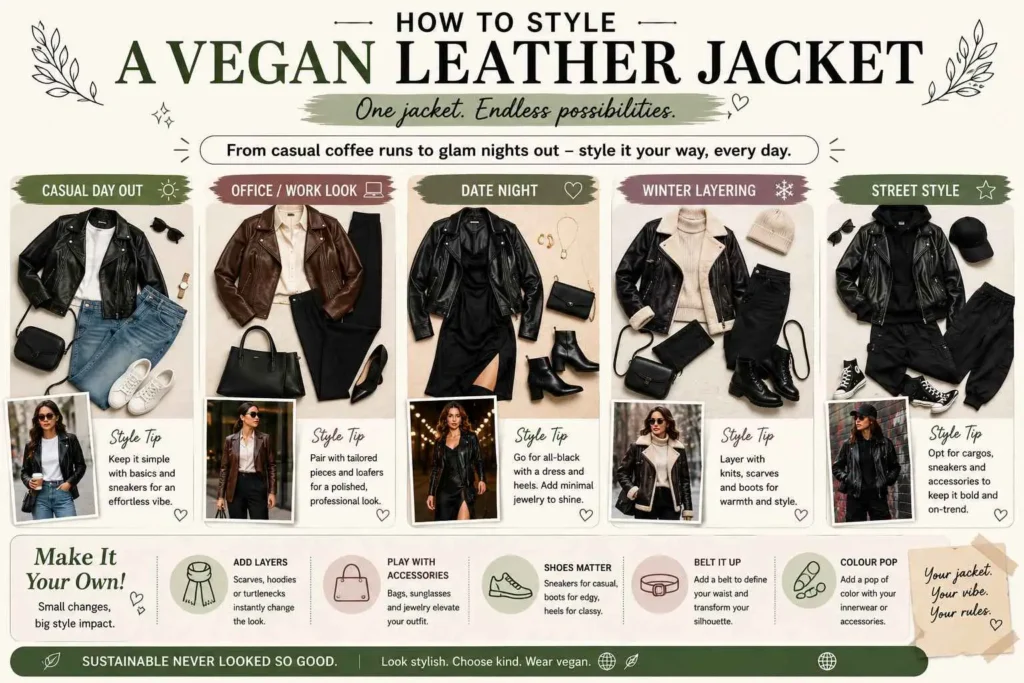
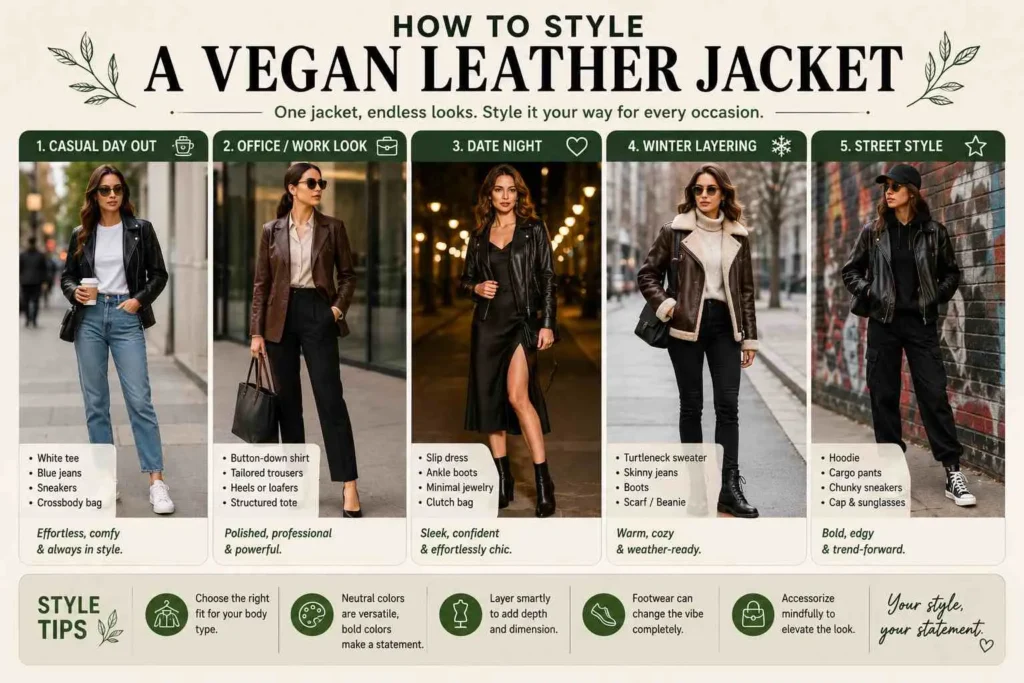
Pair with a plain tee, jeans, and sneakers for an effortless, no-fuss look.
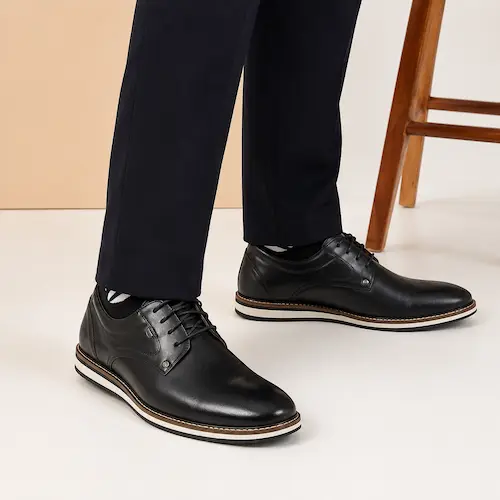
Pair with a plain tee, jeans, and vegan shoes for an effortless, no-fuss look.
A blazer-style vegan leather jacket over a button-down and tailored trousers works well in creative or business-casual offices.
Complete the look with a vegan leather belt for a polished and structured finish.
Layer over a fitted top and dark denim, finished with boots, for an outfit that feels put-together without trying too hard.
For an extra touch of style, pair the outfit with a vegan leather purse that complements the jacket.
Wear over a chunky knit sweater, and add a scarf for warmth without sacrificing the silhouette.
Combine an oversized or hooded jacket with cargo pants and chunky sneakers for an urban, layered look.
Keep the palette to two or three neutral tones and let the jacket’s clean lines do the talking.
Keep the accessories simple with a vegan leather wallet in a matching neutral tone.
High-quality vegan leather can closely mimic the look of animal hide, though genuine leather typically develops a natural grain and patina that’s harder to replicate.
Genuine leather molds to the body over time; vegan leather stays closer to its original shape and can feel slightly stiffer, especially early on.
Well-cared-for genuine leather can last decades and often improves with age. Vegan leather, particularly PU, has a shorter typical lifespan and is more prone to cracking or peeling if neglected.
Vegan leather is generally easier to clean day-to-day (wipe-down care), while genuine leather needs specialized conditioning products and occasional professional treatment.
Vegan leather is almost always significantly cheaper upfront.
Neither material is environmentally neutral. Genuine leather production is tied to livestock farming and water- and chemical-intensive tanning. Standard PU and PVC vegan leather are petroleum-based and not biodegradable. Plant-based vegan leathers generally have a lower footprint but often still include some plastic content.
If cost, cruelty-free sourcing, and low-maintenance care matter most, vegan leather is the practical choice. If you want a piece built to last decades and don’t mind the higher price and upkeep, genuine leather remains hard to beat on longevity.
Material type (PU generally outlasts PVC in flexibility), frequency of wear, exposure to sunlight and heat, and how well the jacket is cleaned and stored all affect lifespan.
A soft, slightly textured (not glossy-plastic) surface, reinforced stitching at stress points, and a lining that doesn’t bunch or separate from the shell are good indicators of a jacket built to last.
Regular gentle cleaning, occasional conditioning with a product made for synthetic materials, and keeping the jacket away from direct heat and prolonged sun exposure are the biggest factors in extending how long it stays wearable.
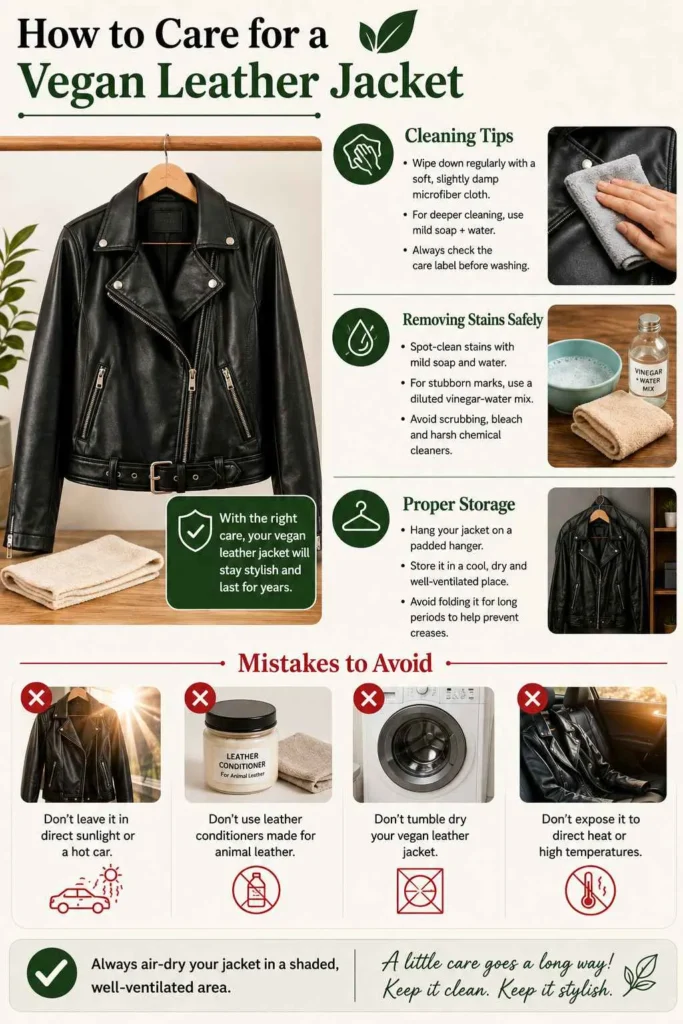
Wipe down regularly with a soft, slightly damp microfiber cloth. Only machine-wash if the care label explicitly allows it, and always use a cold, gentle cycle.
Spot-clean with a mild soap and water solution (or a diluted vinegar-water mix) and a soft cloth — avoid scrubbing, bleach, or alcohol-based cleaners, which can strip the surface finish.
Hang the jacket on a padded hanger in a cool, dry space, ideally inside a breathable garment bag rather than sealed plastic, which can trap moisture.
Don’t leave the jacket in direct sunlight or a hot car, don’t use leather conditioners formulated for animal hide (they can leave residue on synthetic material), and don’t tumble dry — always air dry.
Most vegan leather is water-resistant at the surface, meaning light rain will typically bead and wipe off, but it isn’t fully waterproof.
Occasional light rain is generally fine. Heavy or prolonged rain can seep in through seams, zippers, or the lining, so it’s worth avoiding downpours when possible.
If the jacket does get soaked, hang it to air dry away from direct heat — never near a radiator or in a dryer — since fast, high-heat drying is a common cause of cracking.
Lower-quality PVC is more prone to this, but well-made PU or plant-based options, properly cared for, can last for years without visible cracking.
Standard PU and PVC leather do rely on plastic, but the plant-based category — cactus, apple, mushroom, and pineapple leathers — significantly reduces (though doesn’t always eliminate) plastic content.
Genuine leather comes with its own significant environmental costs, including heavy water use and chemical-intensive tanning tied to livestock farming. Sustainability depends on the specific material and how it’s produced, not simply “animal” versus “synthetic.”
Durability varies widely by material and construction quality. A cheap PVC jacket may wear out quickly, but a well-constructed PU or plant-based leather jacket, cared for properly, can hold up for years.
Look for a lining made from natural or moisture-wicking fabric, since the outer shell itself won’t breathe much.
A matte or semi-matte texture usually signals better quality than a high-gloss, plasticky finish.
Jackets made with recycled polyester backing or recycled PU reduce reliance on virgin plastic.Certifications such as the Global Recycled Standard (GRS) help verify recycled material content and responsible production.
Look for transparency around factory conditions and, where available, third-party certifications covering labor and environmental standards.
A brand confident in its construction quality will typically back the jacket with a reasonable warranty or return window.
Anyone prioritizing cruelty-free sourcing, a lower upfront cost, or easier day-to-day maintenance will likely find a vegan leather jacket a good fit.
Everyday wear, city commuting, and mild-weather layering are where vegan leather jackets perform best.
If you don’t need decades of heavy use or a natural patina, a quality vegan leather jacket can deliver the same look at a fraction of the cost and with a clearer conscience.
PU leather generally offers the best all-around balance of softness, breathability, and durability among common options, while plant-based leathers like cactus or mushroom leather are strong choices for lower environmental impact.
They can, especially lower-quality PVC or PU exposed to heat, sunlight, or poor storage. Proper care significantly reduces this risk.
On their own, not typically — they don't insulate like wool or down. Choosing a jacket with a warm lining, or layering underneath, makes them workable for colder months.
Light rain is usually fine since most vegan leather is water-resistant at the surface, but heavy or prolonged rain can seep through seams and should be avoided when possible.
Wipe with a soft, slightly damp microfiber cloth, spot-clean stains with mild soap and water, and always air dry away from direct heat.
With good care, a well-made vegan leather jacket can last several years; quality and maintenance matter more than the general "vegan vs genuine" label.
They're generally the same category of material — "vegan leather" is simply the more current, broader term that also includes newer plant-based options, whereas "faux leather" traditionally referred to the plastic-based versions.
The shell material itself isn't very breathable, but a well-chosen fabric lining helps offset that for everyday comfort.
Minor scuffs and small tears can often be repaired with vinyl or synthetic-leather repair kits, though options are more limited than for genuine leather.
Jeans and a simple top for a casual look, tailored trousers and a blazer-style jacket for smart casual, or a chunky knit for cold-weather layering.
Vegan leather jackets have earned their place as a genuine alternative to animal hide, not just a budget substitute. The right choice comes down to matching the material — PU, PVC, or one of the newer plant-based options — to how you plan to wear and care for it. Pay attention to construction quality, stitching, and lining over flashy marketing claims, and a good vegan leather jacket can deliver the classic look for years to come, without compromising on ethics or budget.
Choosing a vegan leather jacket is about more than just style. Look for quality materials, comfortable fits, durable construction and brands that are transparent about what their products are made from.
Looking for more cruelty-free fashion options? Explore VegGora’s curated vegan fashion collection and discover products made for a more conscious wardrobe.
Your choices can help protect innocent lives.
No spam. Only vegan tips, cruelty-free updates & animal awareness 🐾


 Vegan FoodBaby & MomBeautyFashionPet & Animal CareHealth & WellnessHome & Cleaning Essentials
No account yet?
Create an Account