

-49% Hot
Price range: ₹359.00 through ₹699.00

-43% Hot

Original price was: ₹699.00.₹399.00Current price is: ₹399.00.

-44% New

Price range: ₹249.00 through ₹449.00
-53% Hot
Price range: ₹300.00 through ₹470.00
 Vegan Food
 Baby & Mom
 Beauty
 Fashion
 Pet & Animal Care
 Health & Wellness
 Home & Cleaning Essentials
Your wallet may be small — but its impact is anything but. Most of us pick one, slip it into our pocket, and never give it a second thought. Yet if it’s made from traditional leather, it comes with hidden costs: toxic chemical processing, deforestation, and animal suffering built into something we use every single day.
Vegan leather wallets change that equation completely. They offer the same style, functionality, and durability — without the ethical or environmental compromise. What was once seen as an “alternative” has now evolved into a smarter, more conscious choice.
And in 2026, these alternatives are better than ever. The global vegan leather market is rapidly expanding, valued at $11.07 billion in 2025 and projected to reach $27.80 billion by 2034, growing at an impressive 10.8% annually, according to Custom Market Insights. This isn’t just a passing trend — it’s a shift in how people think about fashion and sustainability.
In this guide, you’ll discover everything you need to know about vegan leather wallets — from the materials behind them and how they compare to real leather, to expert buying tips and the best options you can invest in right now.

A vegan leather wallet is any wallet made from materials that contain no animal-derived components. No cowhide. No pigskin. No animal by-products of any kind. Instead, these wallets are crafted from a range of synthetic and plant-based alternatives that are designed to look and feel like leather — and increasingly, they do exactly that.
Real leather is made from animal hide — most commonly cowhide — that goes through a chemical-intensive tanning process to prevent it from decomposing. This process uses over 175 different chemicals, according to a report by the IWA Publishing, including chromium salts, sodium sulfide, formaldehyde, and various dyes and acids.
Vegan leather, by contrast, is produced without any animal products. Depending on the type, it may be derived from polyurethane (PU), plant-based fibres like pineapple leaves or cactus, cork, recycled plastics, or microfibre blends. While the processing methods vary significantly by material, none involve animal slaughter or the chemical-heavy hide tanning process.
Not exactly — though these terms overlap. “Faux leather” and “PU leather” are older terms that typically refer specifically to polyurethane or PVC-based synthetic leather. “Vegan leather” is a broader umbrella that includes both synthetic options (like PU) and newer plant-based alternatives (like cactus leather or Piñatex). All PU leather is technically vegan leather, but not all vegan leather is PU leather. As the material category has evolved, “vegan leather” has become the preferred term because it more accurately conveys the full range of animal-free alternatives available today.
Several forces are driving this growth simultaneously. Consumer awareness about the environmental footprint of animal agriculture has increased dramatically. Ethical fashion has moved from a niche concern to a mainstream buying consideration — particularly among younger demographics. And critically, the quality of vegan leather has improved to the point where it genuinely rivals conventional leather in many applications.
Brands like Nike, Hugo Boss, H&M, and Zara have all publicly adopted plant-based leather alternatives, according to reporting from Sourcing Journal and Retail Bulletin, signalling to consumers that these materials are ready for prime time.

This is where things get genuinely interesting. “Vegan leather” covers a surprisingly wide range of materials, each with its own properties, sustainability profile, and feel.
PU leather is the most widely used material in vegan wallets. It’s produced by coating a fabric base (often polyester or cotton) with a polyurethane finish, creating a flexible, smooth surface that closely resembles the look and feel of real leather. PU leather is durable, relatively affordable, and easy to clean — making it a practical choice for everyday wallet use. It is notably more environmentally friendly than PVC leather, which contains toxic chlorine and often releases harmful plasticisers. That said, PU leather is still a petroleum-derived plastic, which limits its eco-credentials compared to fully plant-based options.
Cork is harvested from the bark of cork oak trees — and crucially, the tree itself is never cut down. The bark regrows naturally, making cork a truly renewable material. According to LA Enviro and multiple sustainable fashion sources, cork is naturally water-resistant, lightweight, and durable. It has a distinctive textured appearance that many people find appealing for its natural, earthy quality. Cork wallets tend to be particularly slim and light, which appeals to minimalist wallet users.
Piñatex is one of the most celebrated innovations in the vegan leather space. Developed by Dr. Carmen Hijosa of London-based company Ananas Anam, it is made from the fibres of pineapple leaves — a by-product of the pineapple harvest in the Philippines. According to Ananas Anam’s published data, 27 million tonnes of pineapple leaf waste are produced annually in the Philippines alone, and Piñatex turns this agricultural waste into a durable textile without requiring any additional land, water, or pesticides to produce the raw material.
Most compellingly, Piñatex production emits just 2.69 kg of CO₂ equivalent per square metre — which is 45% less than PU synthetic leather and a remarkable 90% less than animal leather, according to Alternative Leathers Co., citing Ananas Anam’s published data. Piñatex has been adopted by over 1,000 brands worldwide, including Nike, Hugo Boss, H&M, and Hilton Hotels.
Apple leather is made from the cores and peels left over from the juice and food processing industries — turning genuine food waste into a usable textile. It offers a smooth, supple texture and a relatively low environmental footprint.
Cactus leather, pioneered by Mexican company Desserto (Adriano Di Marti), is made from the mature leaves of the nopal (prickly pear) cactus. According to Desserto’s own published data, the nopal cactus requires just 0.02 cubic metres of water per square metre of fabric produced, compared to 32.95 cubic metres for conventional animal leather — a staggering difference. The cactus leaves regenerate within months after harvesting, and Desserto’s 14-acre farm in Zacatecas, Mexico absorbs 8,100 tonnes of CO₂ annually. The material is free of toxic chemicals, phthalates, and PVC, and holds certifications including OEKO-TEX, USDA Organic, and PETA-Approved Vegan.
Some vegan wallets are made from recycled plastic bottles (rPET) or high-quality microfibre blends. These options divert plastic waste from landfill and waterways and can produce a very smooth, leather-like finish. Microfiber leather in particular — made from ultra-fine synthetic fibres — tends to be highly durable, scratch-resistant, and pleasant to the touch.
The most straightforward benefit is the most important one for many people: no animals are harmed in the production of a vegan leather wallet. Every year, the global animal leather industry slaughters over one billion animals, according to Species Unite, citing industry data. Choosing a vegan leather wallet removes your personal demand from that supply chain entirely.
The numbers here are striking. A European Commission-backed report cited by Faunalytics found that tanning just 1 kg of leather uses up to 2.5 kg of chemical substances, up to 250 litres of water, and generates up to 6.1 kg of solid waste. Pre-tanning and tanning operations together contribute approximately 90% of the total pollution caused by the leather industry, according to research published via ScienceDirect.
Furthermore, the livestock farming that produces animal hides is a significant driver of deforestation — particularly in the Amazon. A global life cycle assessment published in 2025 found that the farming stage alone accounts for 68% of the climate change impact of cattle leather production, per Carbon Facts analysis of the study.
Plant-based vegan leathers, particularly materials like Piñatex and Desserto, carry a fraction of this environmental burden.
Vegan leather wallets, particularly those made from PU or microfibre, generally require far less maintenance than genuine leather. Real leather needs regular conditioning with specialist products to prevent it from drying out and cracking. Most vegan leather simply needs wiping clean with a damp cloth — no specialist treatments required. This makes them more practical for everyday use and easier to care for long-term.
High-quality genuine leather wallets from reputable brands can run anywhere from £50 to several hundred pounds. Vegan leather alternatives — even well-made, stylish ones — tend to be more accessible in price, partly because the raw materials cost less and partly because the production process is less labour-intensive. This means you can invest in a genuinely good-looking, ethically made wallet without the premium price tag.

In terms of raw durability, high-quality full-grain animal leather still has an edge over most synthetic alternatives. It can develop a patina over years of use, becoming more characterful with age. However, the durability of vegan leather varies enormously by material. Microfiber leather and newer plant-based materials like Desserto cactus leather are engineered for high abrasion resistance. Desserto’s estimated product lifespan is around ten years, according to Watson & Wolfe. The main weakness of lower-end PU leather is susceptibility to peeling or delamination over time — which is addressed in more detail in the care section below.
For casual observers, distinguishing a well-made vegan leather wallet from a genuine leather one is genuinely difficult. Modern PU leather, microfibre, and plant-based alternatives reproduce the visual and tactile qualities of leather with impressive accuracy. The main giveaway tends to be the smell — real leather has a distinctive scent that most vegan alternatives do not replicate. Some people prefer this, others miss it. It is, ultimately, a matter of personal preference.
Vegan leather wallets typically offer better value for money at the mid-price range. You can spend £20–£50 and get a well-designed, durable vegan wallet from a reputable brand. Comparable genuine leather quality at that price point is harder to find. At the luxury end of the market, the calculus is more nuanced — premium animal leather products can justify their price through exceptional craftsmanship and longevity. But for the average everyday wallet, vegan leather delivers excellent value.
Animal leather loses this comparison decisively when the full life cycle is considered — from cattle farming and deforestation to chemical-intensive tanning and waste generation. PU and PVC vegan leathers are better, but they are still petroleum-based plastics that shed microplastics and don’t biodegrade. The genuine sustainability winners are plant-based options: Piñatex, Desserto cactus leather, cork, and apple leather all carry significantly smaller environmental footprints, particularly when certified with credible third-party standards.
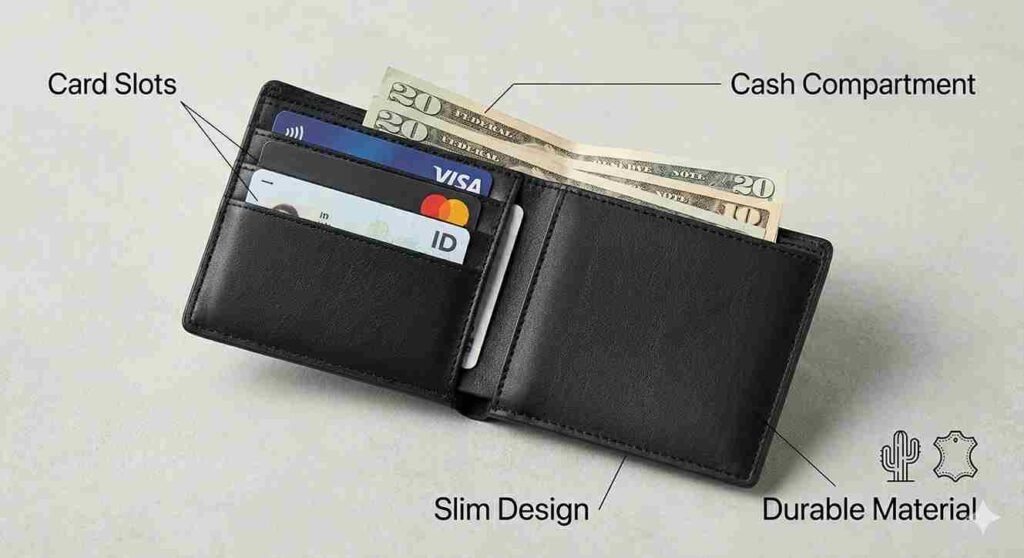
Thicker vegan leather generally means greater durability and a more premium feel. Look for wallets that specify the material composition — a brand confident in its materials will tell you exactly what’s inside. If the listing simply says “vegan leather” with no further detail, that’s a flag that it may be low-grade PU or PVC.
RFID blocking has become a common selling point for wallets. To be fair and accurate: the Identity Theft Resource Center (ITRC) in the US has stated that RFID fraud does not represent a well-documented real-world risk, and the organisation’s COO has publicly said they do not believe it addresses a genuine threat for most consumers, as reported by AARP. Major card issuers like Visa have also stated that fraud from skimming is very unlikely and limited in scope. According to Digital Trends, there has still not been a confirmed real-world crime that an RFID blocking product would have stopped.
That said, if carrying an RFID-blocking wallet gives you peace of mind — particularly if you travel frequently to busy cities — there is no harm in choosing one. Just don’t pay a significant premium for that feature alone.
Think realistically about what you carry. Most people need slots for 4–8 cards, a cash section, and perhaps a coin pocket. Slim wallets with 4–6 card slots are sufficient for minimalists and those who primarily use digital payments. If you carry more cards or cash regularly, a full bifold with 8–12 slots and a note section will serve you better.
Slim wallets (cardholders) are ideal for people who travel light, prefer front-pocket carrying, or live in cities with strong contactless payment infrastructure. They’re also better for reducing bulk in jacket pockets. Full bifold wallets suit people who carry more cards, need cash sections, and want traditional wallet functionality. Both styles are widely available in vegan leather.
When buying, look for credible third-party certifications that back the brand’s sustainability claims. Meaningful certifications include PETA-Approved Vegan (confirms no animal products), OEKO-TEX Standard 100 (confirms no harmful chemicals), Global Recycled Standard (GRS) (confirms recycled content), and B Corp certification (confirms overall social and environmental performance). Brands willing to share their supply chain information and material sourcing are generally more trustworthy than those making vague “eco-friendly” claims without evidence.
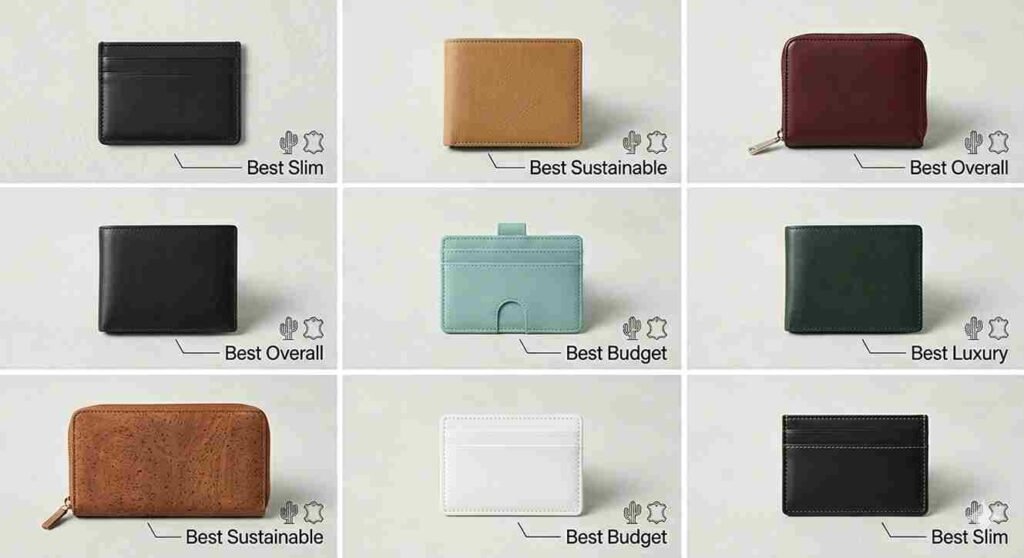
Here are nine wallet picks across different categories, materials, and budgets — each representing the best of what’s available right now.
Matt & Nat has been producing vegan leather accessories for over 20 years, as noted by Sourcing Journal and multiple sustainable fashion publications. Their wallets are made from recycled materials including recycled nylon, cork, rubber, and cardboard, with lining made from recycled plastic bottles. They offer a complete range of bifold and cardholder styles in clean, minimalist designs. For most people looking for a reliable, stylish, everyday vegan wallet, Matt & Nat is the safest place to start.
For a front-pocket slim wallet in PU leather, look for options from brands like Secrid or Dun Wallet — both use minimal materials to maximum effect. Slim card holders that hold 4–6 cards with a quick-access pull tab have become a popular choice for men transitioning away from traditional bifolds.
Women’s vegan wallets tend to offer more colour variety and interior organisation. Brands like Immaculate Vegan and mali + lili carry curated selections of women’s wallets in Piñatex, microfibre, and PU leather that balance style with thoughtful interior layout — multiple card slots, zip coin sections, and phone pockets.
For a genuinely good wallet under £20–25, look for branded PU leather options from vegan-focused online retailers. The key is to avoid unbranded ultra-cheap options where the PU is so thin it will delaminate within months. A slightly higher budget — even £20 — gets you into territory where construction quality is significantly better.
Stella McCartney has been one of the highest-profile luxury brands committed to vegan leather since the brand’s founding. Their accessories line uses no animal leather or fur across any product, and the quality of their vegan leather goods is unimpeachable at the luxury level. For a luxury vegan leather wallet that holds its own against any conventional leather alternative, Stella McCartney remains the benchmark.
Cork wallets stand apart for their unique texture, natural biodegradability, and feather-light weight. Portuguese cork wallets from brands like Corkor and Corkcho are well-regarded for their craftsmanship and durability. Cork is naturally antimicrobial and water-resistant, making it a practical choice for daily use.
If RFID protection matters to you, brands like Bellroy offer RFID-protected slim wallets in vegan leather options. Their materials and construction quality are consistently high, and the RFID blocking is integrated into the wallet’s structure rather than added as a separate insert.
For the truly minimal approach — just cards and nothing else — a slim cardholder in microfibre or PU leather is hard to beat. Look for cardholders with an elastic card band on the back for quick access and between 4–6 interior slots. Small, flat, and indestructible.
For the most environmentally ambitious choice, look for wallets specifically made from Piñatex or Desserto cactus leather. Brands like Watson & Wolfe (UK-based) and Soneha produce wallets using Desserto cactus leather with all the sustainability certifications to back it up — OEKO-TEX, PETA-Approved Vegan, and USDA Organic.
The great news about vegan leather is that it’s low maintenance by design. For day-to-day care, simply wipe the exterior with a slightly damp microfiber cloth to remove dirt, dust, and surface marks. For tougher stains, a small amount of mild soap diluted in water works well — apply gently with a cloth, then wipe clean with a damp cloth and allow to air dry. Avoid harsh cleaning products, bleach, or abrasive cloths, as these can damage the surface coating.
The most common complaint about lower-quality PU leather is that it peels or cracks over time. This typically happens because the PU coating delaminate from the fabric base beneath it. To minimise this risk, avoid prolonged exposure to direct sunlight or extreme heat (such as leaving your wallet on a car dashboard), keep the wallet away from sharp objects that can scratch the surface, and don’t overfill it — constant over-stretching weakens the material at stress points. Higher-quality vegan leathers like microfibre, cork, or plant-based materials are generally much more resistant to this issue.
When not in use, store your vegan leather wallet in a cool, dry place away from direct sunlight. If storing for a longer period, keep it in a soft pouch or cloth bag to protect the surface from scratches. Avoid storing it pressed against sharp-edged items like keys for extended periods.

This is the honest part most brands don’t want to linger on. PU and PVC leathers are both plastics — derivatives of fossil fuels. They don’t biodegrade in any meaningful timeframe. They can shed microplastics during use and washing. And their production, while less harmful than animal leather tanning, still relies on petrochemical processes. Ecocult and Sustainable Jungle have been among the sustainable fashion publications most transparent about this limitation. Choosing a PU wallet over a genuine leather wallet is better — but it is not a perfectly clean option.
The step-change in sustainability comes when you move to plant-based vegan leathers. Piñatex emits 90% less CO₂ per square metre than animal leather and uses agricultural waste as its primary raw material, according to published data from Ananas Anam. Desserto cactus leather uses 0.02 cubic metres of water per square metre of fabric, compared to 32.95 for animal leather — a reduction of over 99.9%, based on data published by Soneha citing Desserto’s reports. Cork is renewable and biodegradable. Apple leather repurposes food industry waste. These materials represent a genuine environmental improvement, not just a marketing message.
Greenwashing in fashion is widespread. When a brand claims their wallet is “eco-friendly” or “sustainable,” the claim only has teeth if it’s backed by credible certification. The most meaningful ones to look for are OEKO-TEX Standard 100 (no harmful chemicals in the product), Global Recycled Standard (verified recycled content), PETA-Approved Vegan (no animal products), B Corp certification (verified social and environmental responsibility across the business), and USDA Organic (for plant-based materials grown to organic standards). A brand carrying several of these certifications is demonstrably more trustworthy than one making unverified claims.
This varies significantly by material. High-quality microfiber leather and plant-based options like Desserto cactus leather are estimated to last around ten years with proper care, according to Watson & Wolfe. Lower-end PU leather wallets may show wear within 2–3 years. As a rule of thumb, the better the construction and the higher the material quality, the longer the lifespan — regardless of whether it's vegan or animal leather.
Lower-quality PU leather can peel or delaminate over time — this is the most common quality complaint. It happens when the top coating separates from the base fabric. However, this is largely a quality issue rather than an inherent flaw of vegan leather as a category. Higher-quality PU leather, microfiber leather, cork, and plant-based materials are significantly more resistant to this problem. Buying from reputable brands and avoiding ultra-cheap options largely mitigates this risk.
Many vegan leather materials offer good water resistance. PU leather and microfiber leather both repel light rain and surface moisture effectively. Cork is naturally water-resistant by its cellular structure. Piñatex has a protective coating applied during finishing that gives it water resistance. No vegan leather wallet should be submerged in water or soaked — but for everyday use in rain or damp conditions, most vegan leather wallets perform well.
Absolutely. The range of men's styles in vegan leather has expanded enormously in recent years. From classic bifolds in PU leather to slim cardholders in cork, microfibre, or Piñatex, there are vegan leather wallets designed specifically with men's style preferences and pocket dimensions in mind. Brands like Matt & Nat, Bellroy, and Corkor all offer well-designed men's vegan wallets at various price points.
For raw environmental credentials, brands using Piñatex or Desserto cactus leather with verified third-party certifications are the most sustainable options currently available. Watson & Wolfe (UK), Soneha, and Immaculate Vegan are good starting points for finding genuinely certified, plant-based vegan wallets. Matt & Nat, while using primarily PU leather, holds strong commitments to recycled materials throughout their supply chain and is one of the more transparent brands in the category.
Yes, unequivocally, and for more reasons than just ethics.
A well-chosen vegan leather wallet gives you everything you need from a wallet: durability, style, practicality, and longevity. It costs you less than most genuine leather alternatives. It requires less maintenance. And it does all of this without the environmental and animal welfare costs that come bundled with conventional leather production.
The key is choosing wisely. Avoid ultra-cheap PU options that will peel within a year. Invest a little more in a properly constructed wallet from a brand that is transparent about its materials. If environmental impact matters most to you, seek out wallets made from Piñatex or Desserto cactus leather — materials that genuinely move the needle on sustainability rather than just avoiding animal products.
The vegan leather market is growing at nearly 11% annually for good reason. The materials have caught up with the values. In 2026, there is simply no compelling reason to buy a wallet that harms animals or the planet when better alternatives exist — and they look every bit as good in your hand.
Your choices can help protect innocent lives.
No spam. Only vegan tips, cruelty-free updates & animal awareness 🐾


 Vegan FoodBaby & MomBeautyFashionPet & Animal CareHealth & WellnessHome & Cleaning Essentials
No account yet?
Create an Account