If you’ve ever picked up a protein powder at the gym or online and wondered whether it fits a vegan lifestyle, you’re not alone. This is one of the most common questions beginners and even long-time fitness enthusiasts ask.
At first glance, whey protein looks highly processed — just a powder in a tub. Nothing about it visually screams dairy. But the reality behind it is very different.
Let’s break it down clearly, honestly, and without confusion.
Is Whey Protein Vegan?
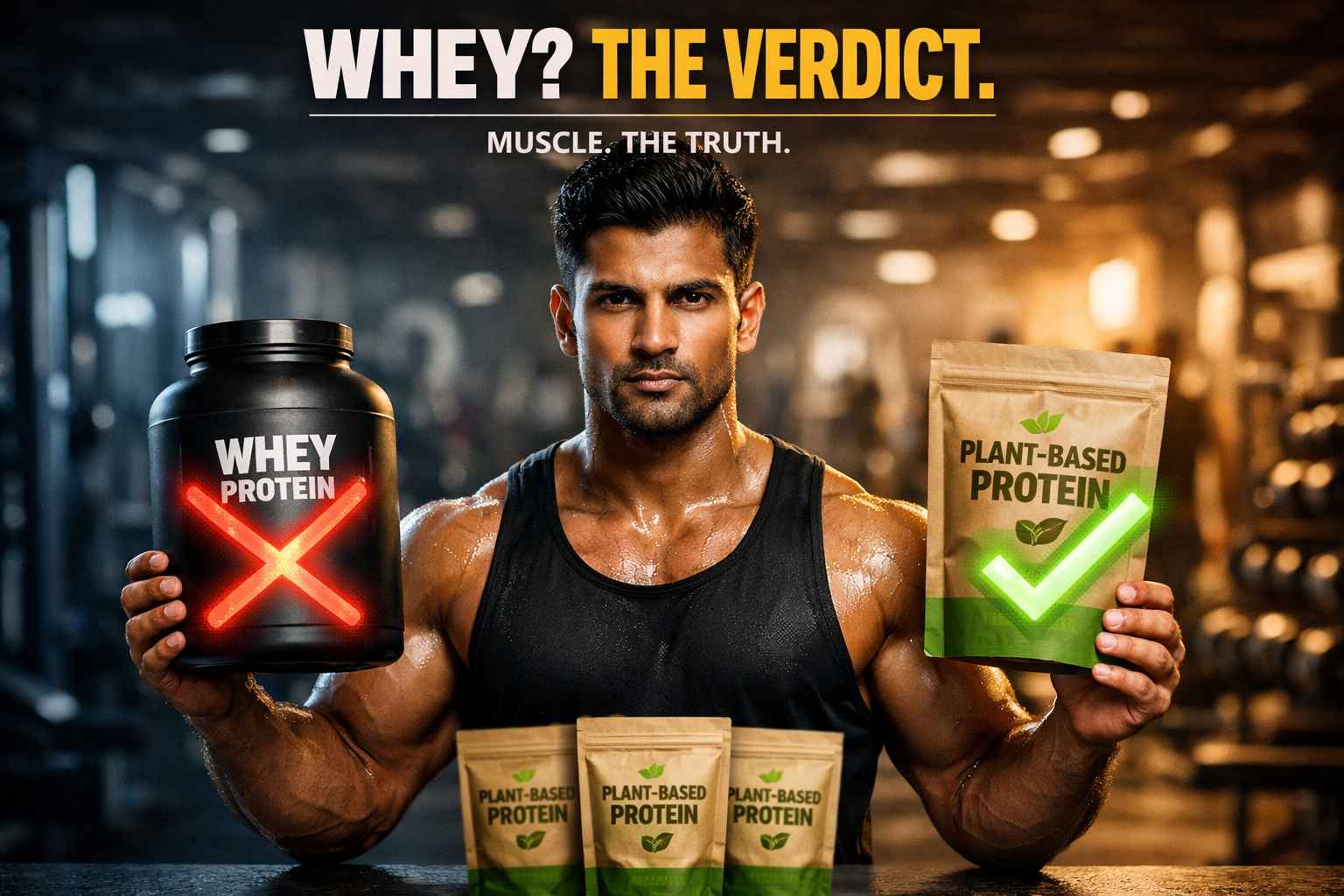
Whey is a dairy product derived directly from cow’s milk. Since vegan diets exclude all animal-derived ingredients, whey protein does not qualify as vegan — regardless of how processed it is.
Whey comes from dairy, which means it doesn’t fit a vegan lifestyle. If you’re building a plant-based diet and need to understand what foods do qualify, our complete plant-based diet food guide is a great place to start.
Why Is There So Much Confusion?
Honestly, the confusion makes sense.
Whey protein:
- Doesn’t look like milk
- Doesn’t taste like dairy
- Is marketed as “clean protein” or “pure protein”
Because of this, many people assume it might be plant-based or at least “neutral.” But processing does not change the origin of a product.
Even if whey is filtered, dried, and refined — it still comes from milk.
Who Should Care About This Answer
This matters most to three groups of people: vegans who want to confirm what they already suspect, vegetarians trying to understand where whey falls on their personal spectrum, and gym-goers or beginners who are newer to protein supplementation and haven’t yet gone deep on where their supplements actually come from.
No matter which group you’re in, this guide has you covered.
What Is Whey Protein Made Of?
Whey protein is a group of proteins naturally found in milk. It accounts for roughly 20% of the total protein in cow’s milk, with casein making up the remaining 80%. It is prized in the sports nutrition world for being a complete protein — meaning it contains all nine essential amino acids — and for being rapidly digested and absorbed by the body.
How Whey Is Produced
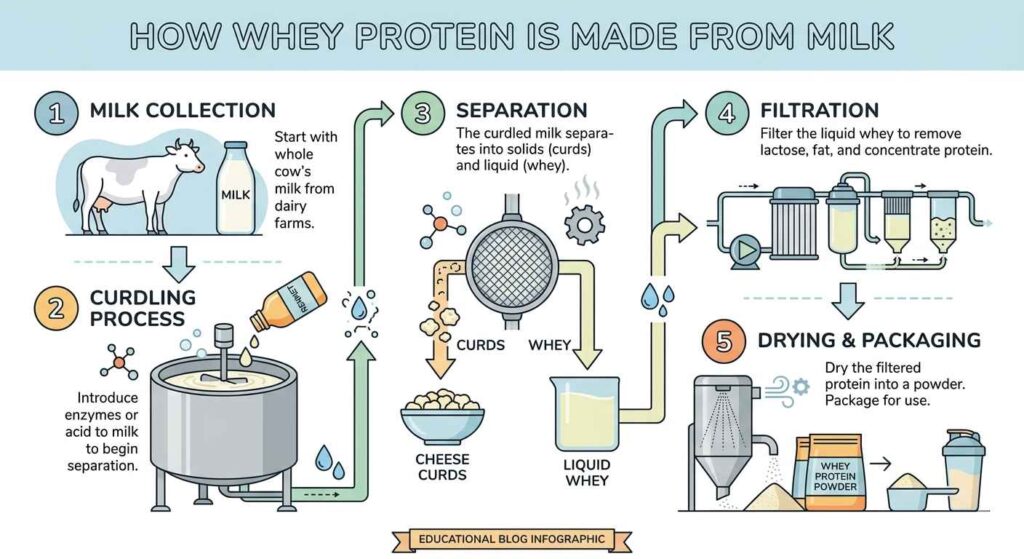
Here’s something most people don’t know: whey protein starts its life not in a supplement factory, but in a cheese factory.
When cheese is made, milk is curdled using enzymes or acids to separate the solid curds from a liquid. That liquid left behind is whey — technically called “milk serum.” As noted in a widely cited review published on ScienceDirect, approximately 90% of the volume of milk used in cheese production is converted into whey. For decades, this liquid was treated as waste and discarded. Today, it’s a multi-billion-dollar industry.
According to research published in the Dairy Processing Handbook, the whey produced from making hard cheeses like cheddar is known as “sweet whey” with a pH of around 5.9–6.6. After collection, this liquid is filtered, pasteurized, and then processed through membrane filtration to remove water and concentrate the protein. The resulting concentrate is then spray-dried into the powder that ends up in your protein shake.
One remarkable scale figure: according to the American Dairy Science Association, approximately nine pounds of whey are produced for every single pound of cheese made — a staggering volume that explains how the supplement industry has been able to build itself almost entirely around what was once a waste stream.
Types of Whey Protein (Concentrate, Isolate, Hydrolysate)
Not all whey protein powders are the same. There are three main forms, each processed to a different degree:
Whey Protein Concentrate (WPC) contains roughly 70–80% protein by weight, along with some remaining lactose and fat. It’s the most affordable form and the most commonly available.
Whey Protein Isolate (WPI) is processed more extensively to remove most of the lactose and fat, resulting in a protein content of 90% or higher. It is often better tolerated by those with mild lactose sensitivity.
Whey Protein Hydrolysate is pre-digested and partially broken down, allowing for even faster absorption. It’s often used in medical protein formulas and infant nutrition products.
All three forms originate from cow’s milk, making all three non-vegan by definition.
Why Whey Protein Is NOT Vegan
Whey Comes from Animal Milk (Dairy Source)
The reason is not philosophical or debatable — it’s biological. Whey protein is a direct byproduct of bovine (cow’s) milk. According to Wikipedia’s well-sourced entry on whey, it is defined as “the liquid remaining after milk has been curdled and strained,” making it a dairy product by origin and by nature.
Dairy products come from animals. Cows must be milked to produce this whey. There is no version of traditional whey protein that skips this step.
Vegan Diet Rules Explained (No Animal Products)
The Vegan Society — the organization that coined the term “veganism” in 1944 — defines the philosophy as one that “seeks to exclude, as far as is possible and practicable, all forms of exploitation of and cruelty to animals for food, clothing or any other purpose.” In dietary terms, this means dispensing with “all products derived wholly or partly from animals.”
Dairy fits squarely in this category. As ScienceDirect’s overview of vegan diets states, a vegan diet “excludes all animal products such as eggs, dairy products, and honey.” Whey protein is a dairy product, full stop.
Common Misconception: "It's Processed, So It's Vegan?"
A surprisingly common line of thinking goes like this: “But it’s been processed so many times — it’s basically just protein molecules at this point. Does it really count as dairy?”
It does. Processing does not change the origin of a product. Leather is processed. Gelatin is processed. The degree of industrial transformation a food undergoes doesn’t erase where it came from. Whey protein concentrate, isolate, and hydrolysate are all derived from cow’s milk — the processing simply purifies and concentrates the protein. The animal source remains unchanged at every step.
Is Whey Protein Vegetarian vs Vegan? (Important Difference)
Why Vegetarians Can Consume Whey
Vegetarianism and veganism are not the same thing, even though the two are often confused. As Britannica explains, vegetarians who follow a lacto-vegetarian diet “may choose to consume some animal-derived foods such as milk, eggs, and honey on the grounds that animals do not need to be slaughtered to obtain these products.”
Since producing whey doesn’t require killing a cow, lacto-vegetarians can and do consume whey protein without any conflict with their dietary principles.
Why Vegans Avoid It Completely
Vegans hold a broader ethical position. The concern is not only about slaughter but about the exploitation of animals at every level of the supply chain. As Animal Equality points out, the dairy cycle on factory farms typically involves repeated forced impregnation of cows to sustain milk production, followed by the separation of calves from their mothers shortly after birth. From a vegan standpoint, this constitutes exploitation, regardless of whether the cow is killed in the process.
This is why the vegan position on whey is unambiguous: it’s an animal product derived from a system that causes animal harm, and it is therefore not consistent with vegan values.
Dairy Industry & Ethical Considerations
It’s worth acknowledging that vegans come to this conclusion for a mix of ethical, environmental, and health reasons. The dairy industry is environmentally resource-intensive, and the scale of industrial dairy farming raises serious animal welfare concerns for many people. Whether you share those concerns or not, the factual answer remains the same: whey protein is not vegan.
Can Any Whey Protein Be Vegan? (Myth vs Reality)
"Vegan Whey" – What Does It Mean?
You may have seen products marketed as “vegan whey” or “animal-free whey.” This sounds contradictory — and in the traditional sense, it is. But a small number of companies have genuinely developed a new category of product that deserves a closer look.
Lab-Grown / Fermentation-Based Whey Explained
The most notable player in this space is Perfect Day, a Berkeley-based biotech company founded in 2014. According to their own published information and Wikipedia’s entry on the company, Perfect Day uses a process called precision fermentation — engineering microflora with the DNA blueprint that cows normally use to produce milk proteins, then growing these microorganisms in fermentation tanks where they convert plant-based carbohydrates into whey protein.
The result is a product that is molecularly identical to conventional cow’s whey, but produced entirely without an animal in the process. It contains no lactose, no hormones, and no cholesterol.
As of 2026, Perfect Day’s Gujarat, India production facility is on track for initial operations in the second half of 2026 with a controlled ramp-up into 2027, according to reporting by AgFunder News. Major brands including Nestlé, General Mills, and Mars have explored partnerships using this technology.
Are These Truly Vegan or Just Marketing?
This is genuinely contested. Perfect Day itself acknowledges that its fermentation-based whey is not dairy-free (it still contains milk proteins and is labeled with a milk allergen warning). However, because no animals are involved in its production, some in the vegan community consider it ethically acceptable.
A key complication: Perfect Day also confirmed that in order to gain regulatory approval for their new ingredient, they were required to conduct animal testing — a fact they state openly and say they find regrettable.
The short answer: fermentation-based whey sits in a gray area. It’s not conventional dairy, but whether it qualifies as “vegan” depends on which ethical framework you’re applying. Most certified vegan organizations have not yet made a clear ruling on precision-fermented animal proteins. For the majority of vegans, the traditional and clear answer remains avoid whey and choose plant-based alternatives.
Best Vegan Alternatives to Whey Protein
Plant-Based Protein Options (Pea, Soy, Rice, Hemp)
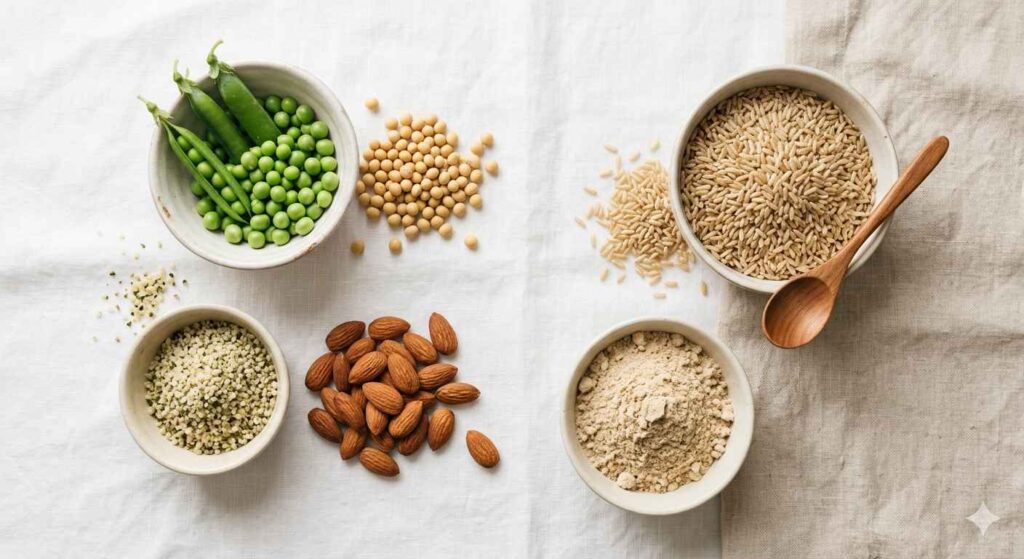
The good news is that the plant-based protein market has exploded in recent years, and there are now genuinely excellent options available. The main players are:
Pea Protein — Derived from yellow split peas, this has become the most popular whey alternative. It has a strong amino acid profile, is widely available, and is free from the top eight allergens (unlike soy).
Soy Protein — The original plant-based complete protein, soy contains all nine essential amino acids. It’s highly researched and effective, though some people prefer to avoid it due to concerns about GMO sourcing or sensitivity to phytoestrogens.
Brown Rice Protein — A solid option that pairs beautifully with pea protein to fill amino acid gaps, particularly methionine.
Hemp Protein — Contains omega-3 fatty acids alongside protein, making it a nutritious whole-food option, though it’s lower in protein per gram than the others.
Which Vegan Protein Is Closest to Whey?
Research published in the Journal of the International Society of Sports Nutrition conducted a 12-week double-blind clinical trial comparing pea protein to whey protein during resistance training. The conclusion? There was no statistically significant difference between the two groups in terms of muscle thickness or strength gains. A 2024 study published in the American Journal of Clinical Nutrition by researchers at McMaster University found that integrated muscle protein synthesis rates were identical between whey and pea protein supplementation in older adults.
Based on current evidence, pea protein is the closest plant-based equivalent to whey protein in terms of real-world muscle-building outcomes.
Complete vs Incomplete Proteins Explained
A “complete protein” is one that contains all nine essential amino acids in adequate amounts. Whey is a complete protein. Pea protein technically contains all nine essential amino acids but is considered low in methionine, making it not quite complete on its own.
However, this matters far less than many people assume. As long as you’re eating a varied diet throughout the day that includes different plant-based food sources, you’ll get all the amino acids you need. Eating a diverse diet, not “protein combining” at every meal, is all that’s required.
Blended Plant Proteins (Best Choice for Muscle Gain)
If you want to maximize amino acid completeness, a blended plant protein that combines pea and rice protein (or pea and hemp) is often considered the best overall choice for vegans focused on muscle building. Research published in Current Developments in Nutrition in 2024 found that when plant-based protein blends were fortified with leucine to match whey’s leucine content, they stimulated muscle protein synthesis at comparable rates to whey protein isolate.
Whey vs Vegan Protein – Which Is Better?
Protein Quality & Amino Acid Profile
Whey protein is widely regarded as one of the highest-quality proteins available. It scores a perfect 1.0 on the PDCAAS (Protein Digestibility Corrected Amino Acid Score), and its leucine content is notably high — approximately 105 mg of leucine per gram of protein, compared to around 81 mg for pea protein. This 25% leucine advantage makes whey marginally superior for rapid muscle protein synthesis stimulation.
That said, research suggests this difference matters less than it might sound. Studies show that as long as you hit the threshold leucine dose (approximately 0.7 — 3 grams per serving according to the International Society of Sports Nutrition), additional leucine doesn’t meaningfully amplify muscle building.
Muscle Building & Recovery
For practical purposes, both whey and high-quality plant proteins support muscle growth and recovery effectively when consumed in adequate amounts. The 2024 McMaster University study showed identical muscle protein synthesis rates between whey and pea supplementation in older men. A 2023 Frontiers in Nutrition study with soccer players found no significant difference in strength, performance, or body composition between pea and whey protein groups over the study period.
Digestion & Lactose Intolerance
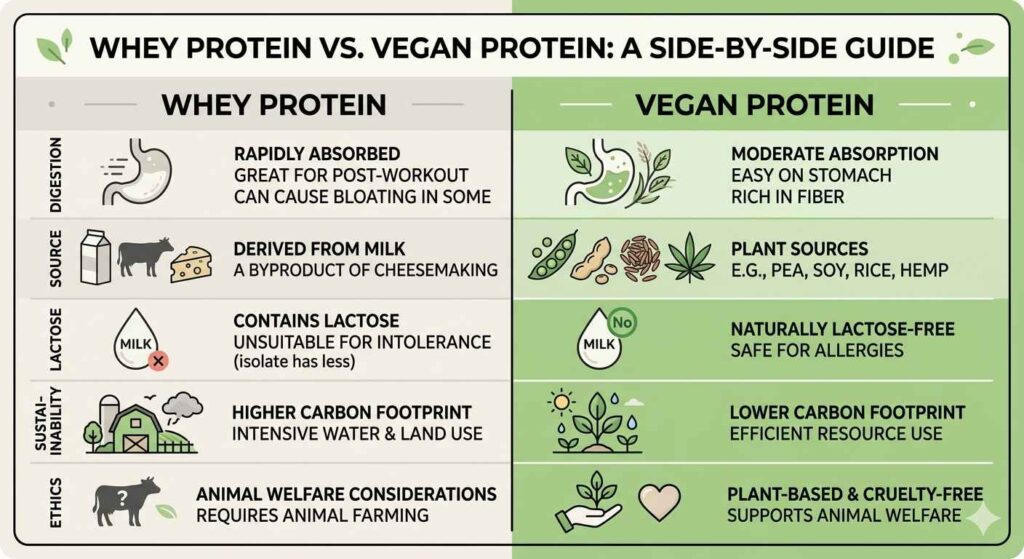
Lactose intolerance is remarkably common — according to a widely cited statistic, nearly two-thirds of the global adult population has some degree of reduced ability to digest lactose. Whey protein concentrate contains lactose and can cause bloating, cramping, and digestive discomfort for people with this condition. Whey isolate contains very little lactose and is usually better tolerated. Plant-based proteins contain no lactose at all, making them a clear winner for digestive comfort in lactose-sensitive individuals.
A true dairy allergy (immune-mediated, not just intolerance) is a separate concern. Anyone with a diagnosed milk allergy should avoid all forms of conventional whey completely, as exposure can trigger reactions ranging from hives and digestive distress to life-threatening anaphylaxis.
Sustainability & Environmental Impact
The dairy industry carries a significant environmental footprint. Producing milk requires substantial land, water, and feed resources and contributes meaningfully to greenhouse gas emissions. Plant-based proteins generally require fewer resources to produce, though environmental impact varies by protein source and region. Pea protein, for instance, is noted for its low environmental impact and the nitrogen-fixing properties of pea crops, which can reduce the need for synthetic fertilizers.
| Feature | Whey Protein | Vegan Protein |
|---|
| Source | Animal (milk) | Plants |
| Vegan | ❌ No | ✅ Yes |
| Digestion | Medium | Easy |
| Lactose | Yes | No |
| Ethical | ❌ | ✅ |
| Sustainability | Lower | Higher |
Should You Avoid Whey Protein If You're Not Vegan?
Who Should Use Whey Protein
If you’re not vegan or vegetarian, have no dairy allergy, are not lactose intolerant, and are looking for a highly researched, rapidly absorbed, complete protein supplement — whey protein remains an excellent choice. It is extensively studied, widely available, cost-effective, and effective for supporting muscle protein synthesis and recovery.
Who Should Avoid It (Lactose Intolerance, Acne, Allergies)
Several groups may want to reconsider whey:
People with lactose intolerance should choose whey isolate over concentrate, or switch to a plant-based protein to avoid digestive discomfort entirely.
People with dairy or milk allergies must avoid whey protein in all its conventional forms. A whey protein allergy is an immune response, not just a digestive issue, and can be life-threatening in severe cases.
People with acne-prone skin may want to pay attention. Research does suggest an association between dairy consumption and acne, particularly related to dairy’s ability to stimulate insulin-like growth factor 1 (IGF-1), which promotes sebum production. A case-control study published in PMC found that among male adolescents, non-dietary protein supplement use (including whey) was statistically more common in the acne group than the control group. The evidence here is associational, not conclusively causal, and responses vary widely between individuals — but if you’re acne-prone and using whey protein heavily, it’s worth paying attention to how your skin responds.
Health Pros and Cons
Pros: Complete amino acid profile, fast absorption, excellent leucine content, well-researched for muscle gain and recovery, convenient and widely available.
Cons: Derived from dairy (off-limits for vegans), contains lactose in concentrate form, potential allergen risk, possible skin sensitivity in acne-prone individuals, environmental impact of dairy production.
How to Choose the Right Protein Powder (Vegan or Not)
Key Factors to Consider (Ingredients, Protein %, Additives)
Whether you’re choosing whey or a plant-based alternative, the key things to evaluate are:
Protein percentage per serving: Look for at least 20–25g of protein per serving. Products that list “protein blend” with a suspiciously low per-serving protein amount may be padding with fillers.
Ingredient list length: Shorter is generally better. A quality protein powder needs very few ingredients.
Added sugars and artificial sweeteners: Some products load up on sweeteners to compensate for unpleasant taste. Check labels carefully.
Third-party testing: The FDA does not require pre-market approval for supplements. Look for products certified by NSF, USP, or Informed-Sport to ensure what’s on the label is what’s actually in the tub.
Label Reading Guide
When reading a protein powder label, scan for: serving size (make sure you’re comparing apples to apples), the protein source (whey concentrate vs. isolate, or which plant protein), the presence of “proprietary blends” (which can hide the actual amounts of each ingredient), and allergen statements.
For vegans specifically: look for a certified vegan logo from The Vegan Society or a similar recognized body, and check that no dairy ingredients appear anywhere on the label — including casein, lactose, or milk derivatives.
Beginner Buying Tips
If you’re just starting out, don’t be overwhelmed. Here’s a simple framework: decide your dietary approach first (vegan/vegetarian or not), then set a protein goal (most active adults benefit from 1.2–2.0g per kilogram of body weight per day, according to current sports nutrition guidelines), and choose a product that makes hitting that goal simple, affordable, and easy on your digestion. You do not need to spend a lot of money to get a good protein powder.
FAQs About Whey Protein and Vegan Diet
Final Verdict – Should Vegans Use Whey Protein?
Clear Conclusion (No, Not Vegan)
The answer is clear: whey protein is not vegan. It is derived from cow’s milk, produced as a byproduct of the dairy and cheese industry, and is fundamentally incompatible with a vegan diet as defined by every major vegan organization worldwide.
There is no form of traditional whey protein — concentrate, isolate, or hydrolysate — that changes this fact. The degree of processing is irrelevant to the question of origin.
Best Recommendation for Vegans
If you are vegan and want a protein supplement, opt for a certified plant-based protein powder — ideally one that has been third-party tested for quality and purity. Pea protein (alone or blended with rice protein) is currently the best-researched and most effective vegan alternative to whey, with multiple peer-reviewed studies showing comparable muscle-building outcomes. Soy protein is also a complete protein and a solid option if you have no sensitivity to soy.
For maximum nutritional coverage and amino acid completeness, a blended plant protein containing both pea and rice is hard to beat.
Quick Summary Points
- Whey protein comes from cow’s milk — it is a dairy product.
- It is produced as a byproduct of the cheese-making process.
- It is not vegan, though it is acceptable for lacto-vegetarians.
- Fermentation-based whey exists but remains niche and ethically debated within the vegan community.
- Pea protein is the best-studied plant-based alternative, with comparable muscle-building results in multiple clinical trials.
- Always choose a third-party tested product, whether whey or plant-based.
Bonus: Top Vegan Protein Picks
Note: The following recommendations are based on product categories supported by research, not paid placements. Always verify current formulations before purchasing.
Best for Muscle Gain
A pea + rice protein blend with at least 25g of protein per serving and fortified with additional leucine (sometimes called “enhanced” or “boosted” plant protein) is the category best supported by current research for muscle building. Look for products with a PDCAAS or DIAAS score listed on the label — these are the most reliable indicators of protein quality.
Best for Beginners
A straightforward unflavored or lightly flavored pea protein isolate is the ideal starting point. It mixes easily, digests well, has no allergen concerns (unlike soy), and is available at almost every price point. Starting simple lets you evaluate how your body responds before committing to a larger purchase.
Best Budget Vegan Protein
Soy protein isolate remains one of the most affordable, complete, and well-researched plant proteins on the market. It has been studied for decades, is globally available, and delivers a complete amino acid profile at a competitive price per gram of protein. If you have no sensitivity to soy and are looking to maximize your protein budget, soy isolate is worth considering.