If you’ve been vegan for a while, you’ve heard this one a hundred times. Flaxseeds. Chia seeds. Walnuts. That’s your omega-3, sorted.
Except it’s not, not entirely. There’s a gap in that advice that most people only stumble onto once they’re actually trying to pick a vegan DHA supplement, standing in front of a supplement aisle (or scrolling one), trying to figure out which bottle is worth buying.
ALA and DHA keep getting treated as the same thing. They’re not.
Flaxseed and chia give you ALA, not DHA. That’s the part people miss. Your body does convert some ALA into EPA and DHA, but the DHA part barely happens, the NIH’s own numbers on this are pretty low. So no, that spoon of flaxseed in your morning smoothie isn’t doing what an actual DHA supplement does.
That’s the gap algae-based DHA fills. Algae is a primary source of the DHA that enters the marine food chain, and algal oil lets you get it directly, without the fish.
For anyone comparing vegan omega-3 products, the confusing part usually isn’t finding a product. It’s knowing what actually matters on the label. Open any supplement app and you’ll find twenty different “vegan omega-3” products, all claiming to be the best one. Some are genuinely good. A lot of them just have good packaging. Here’s how to actually tell the difference in 2026.
ALA, EPA, DHA. What's the difference anyway?
Quick refresher before we go further.
ALA comes mostly from plants, flaxseed and walnuts being the usual suspects. EPA and DHA are long-chain omega-3 fatty acids with distinct roles in the body, while DHA is especially concentrated in the brain and retina, based on research from the NIH Office of Dietary Supplements.
Your body converts some ALA into DHA, just not much of it. This doesn’t mean flaxseed is useless, it’s still a solid food to have around. It just means you shouldn’t treat it as a replacement for an actual DHA source. Keep that in the back of your mind while comparing products.
Why algae, and not fish, should be your DHA source
Here’s something a lot of people don’t realize. Fish don’t make DHA. Algae does. Fish just eat the algae (or eat something that ate the algae), and that’s how DHA ends up in fish oil in the first place.
So algal oil is really just cutting out the middleman. You get the same compound, without touching anything that came from an animal.
That part is easy to understand. The harder part is that “algae-based” alone doesn’t tell you much. It’s the starting point of your research, not the finish line.
What to Check Before Buying a Vegan DHA Supplement
Most of what’s printed on the front of a supplement bottle exists to sell you the bottle. The useful stuff is usually in smaller text on the back.
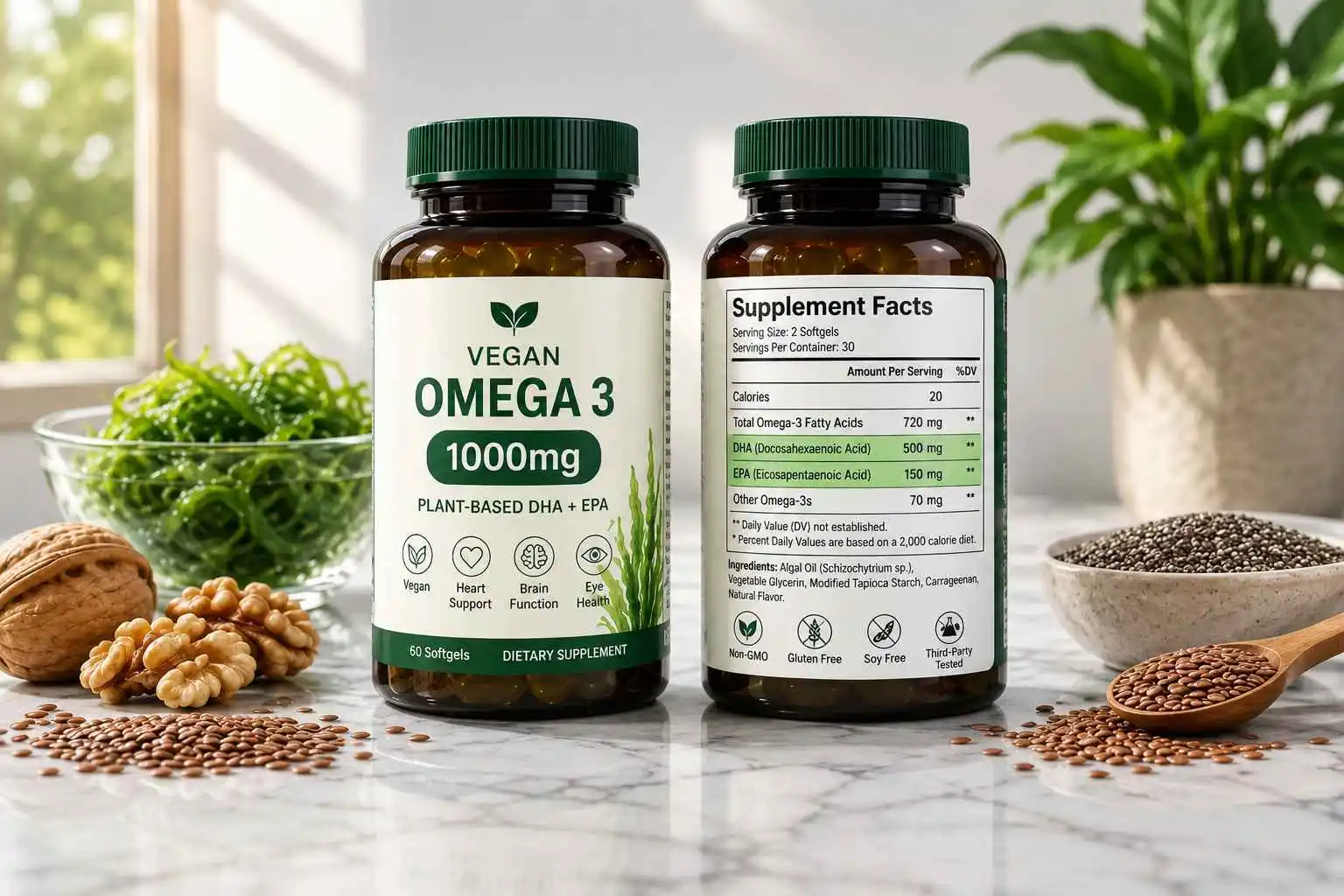
- Check the actual DHA number, not the total oil number. This one trips up a lot of buyers. A bottle might say 500mg of algal oil per capsule. That does not mean 500mg of DHA. Look for the actual DHA content on the supplement facts panel. That’s the only number worth comparing across brands.
- Make sure the source is clearly stated. It should say algal oil, or algae-derived DHA, somewhere on the label. If a product just says “plant-based omega-3” and nothing more, be a little skeptical. Brands that are confident in their formulation are usually upfront about where the DHA comes from.
- Don’t stress about the “perfect” EPA to DHA ratio. Some marketing makes this sound like advanced math. It really isn’t. Some algae oils lean heavier on DHA, others balance both. There’s no universal winner here, it depends on what you’re personally after. If DHA is your main goal, check that number first and worry about the rest later.
- Look for any mention of testing. Batch testing, third-party verification, contaminant screening, whatever the brand can show you. You don’t have to walk away from every product that lacks a fancy certification logo, but a brand that offers zero information about quality is a bit of a red flag.
- Actually read the ingredient list. “Vegan” on the label is a start, not a guarantee. Check the capsule material and any fillers. Takes ten seconds and can save you from buying something that isn’t quite what you thought.
Mistakes people keep making
- Going for the biggest number on the bottle. Bigger doesn’t mean better. Compare DHA per serving, always.
- Assuming flaxseed already covers it. It doesn’t, not the way a direct DHA source does, mainly because that conversion rate is so low.
- Picking based on price alone. The cheapest bottle can end up being the worst deal once you actually calculate DHA per rupee.
- Buying into every claim on the label. If a bottle promises better memory, less anxiety, weight loss, thicker hair, and a stronger immune system all at once, take a step back. DHA may support several of these areas, according to ongoing research, but it isn’t a cure-all on its own.
A short checklist before you buy
- Is the DHA actually algae-sourced?
- How much DHA per serving, specifically?
- Is the serving size clear on the label?
- Are all the ingredients listed openly?
- Is the capsule itself vegan?
- Does the brand mention any testing or quality checks?
- Does this actually suit what you need?
- Are you comparing DHA content, not sticker price?
Get through most of these and you’re already doing better than most buyers out there.
If you want to go deeper into how vegan DHA stacks up against fish oil specifically, Fish Oil vs Vegan Omega-3 – Which Is Safer for Indians? covers it in more detail.
Does every vegan actually need this?
Honestly, it depends.
A well-planned vegan diet gives you a decent amount of ALA from whole foods, and that alone doesn’t mean you’re DHA deficient. Some people still prefer a direct algae source instead of leaning on the body’s own conversion process, and that’s a fair call too.
Your diet, age, and health background all play into this. According to Harvard T.H. Chan School of Public Health, needs can vary by life stage, so if you’re pregnant, breastfeeding, or managing a health condition, it’s worth talking to an actual professional instead of deciding this from an article online.
For most healthy adults though, it comes down to one simple thing. Know what’s actually in the bottle. Don’t let words like “vegan” or “premium” do your thinking for you.
Bottom line
You don’t need a chemistry degree to buy a decent vegan DHA supplement.
- Look for algae-derived DHA
- Check the actual amount per serving
- Look for some sign of quality testing
- Compare products by what’s genuinely inside the capsule, not by whatever claim is printed the loudest
Flaxseed and chia still deserve a spot in your diet. They’re just not a substitute for direct DHA. Once you get that distinction, the whole shopping process gets a lot less confusing, and a lot more about making an actual informed choice. Next time you’re comparing bottles, start with the DHA number on the back label, not the claims on the front.